
A Literary Walk Through Melbourne: Collins Street, Culture, and the Athenaeum
After a quiet walk along Collins Street, where the city exhales between sandstone façades and glassy reflections, we slow our pace. There is a particular hour when the light softens here, when the pavement gleams just enough to feel cinematic, and it is in this pause that a gem reveals itself to those who love words the way some love jewels.
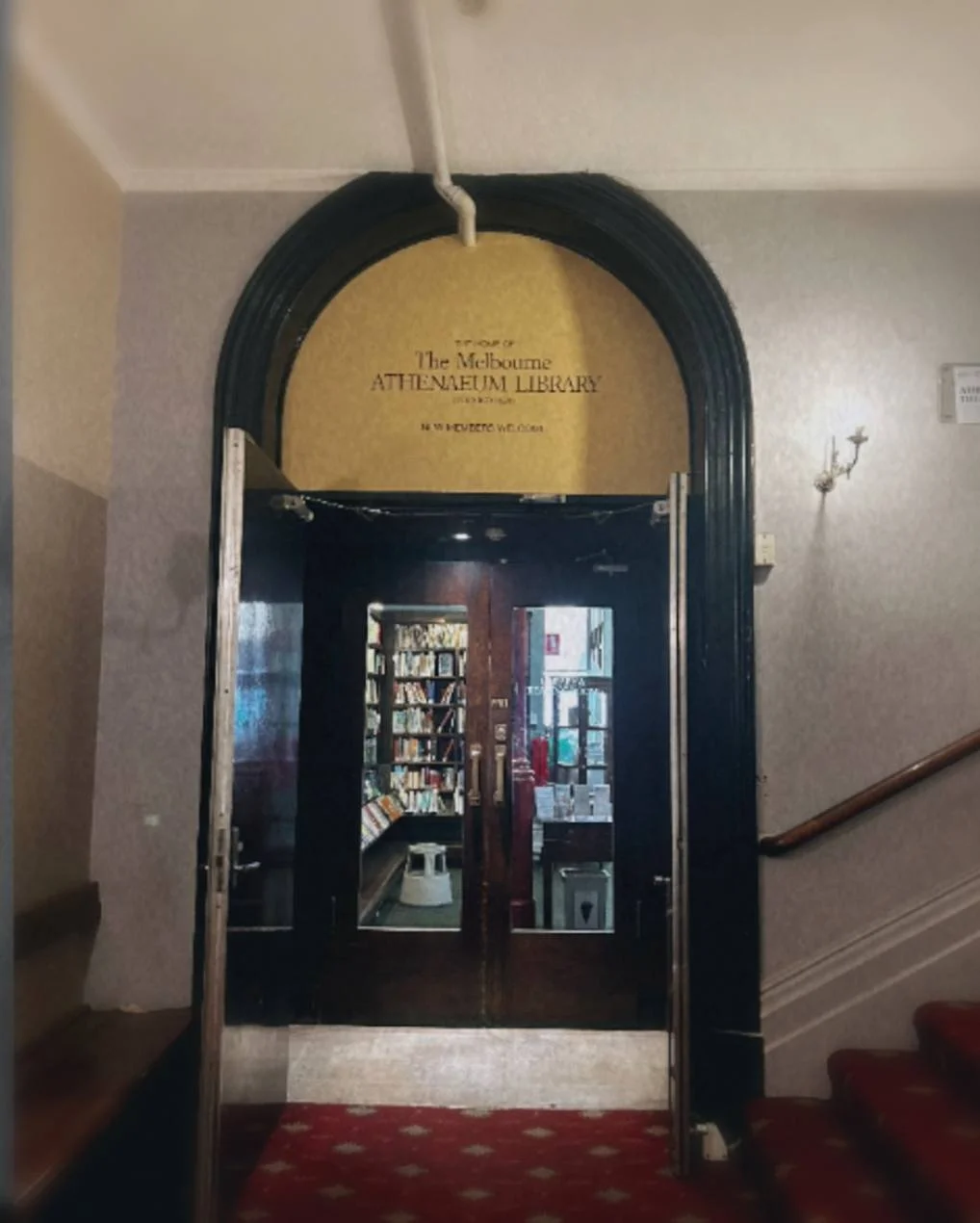
Tucked at the heart of the city, the Melbourne Athenaeum beckons patiently, dignified, certain that the right people will arrive at her doorsteps.
Founded in 1839, the Athenaeum has been an integral part of Melbourne’s cultural fabric for nearly two centuries. Joining a lineage of readers, thinkers, musicians, and conversationalists who believe that culture is a civic responsibility.
We feel it immediately: the presence in the silence of the library. Shelves rise with quiet authority, holding over 30,000 titles that chart the evolution of thought, imagination, and dissent. This library is a living archive, breathing through time. The Athenaeum has hosted music performances, talks, and cultural events that ripple outward into the city, and musicians often note the acoustics here, how sound carries with a warmth that feels almost intentional, as though the building itself understands cadence and pause.
We like to think of this place as a hinge: between past and present, between solitary reading and collective exchange. It is also part of a wider network of literary institutions that make Melbourne what it is, a city that consumes culture, produces it, debates it, and archives it with care. In 2008, Melbourne joined the UNESCO Creative Cities Network as a City of Literature. Melbourne’s literary life spills into laneways, tram stops, bookshops, theatres, and places like the Athenaeum, where access is framed as an invitation.
As a creative collective, we are drawn to cities that allow for this kind of permeability. We are interested in how culture circulates, how ideas move from page to stage, from private reflection to public discourse. Exploring Melbourne through this lens means following the quieter markers: libraries over landmarks, conversations over crowds, heritage spaces that continue to host contemporary voices without apology.
The Athenaeum exemplifies this balance. It is historic without being ossified. Its programming reflects a belief that culture is most alive when it is shared, when a talk sparks a debate that continues down Collins Street, when a performance lingers in the body long after the final note fades.
This is what we mean when we speak of lifestyle and cultivation. A way of moving through the city that prioritises depth. This sensibility comes with discernment: knowing where to go, when to linger, what to read, and how to listen. Elegance, to us, is an informed curiosity paired with humility.
From the Athenaeum, we step back into the city with softened edges. Collins Street resumes its cadence, now attuned to the layers beneath the surface. We think about how many such places exist across Melbourne, quietly sustaining its reputation as a literary capital. Independent bookshops, writers’ centres, small theatres, reading rooms, and community spaces form a constellation that is best navigated slowly.
To support this exploration, our curatorial field guides have compiled a map, one that traces Melbourne’s literary and cultural nodes, both iconic and overlooked. Like any good guide, it leaves room for discovery, for detours prompted by curiosity or chance. The map reflects our belief that culture is participatory: it grows richer when more voices contribute, when readers become writers, when observers become interlocutors.
We share this as companions. Our role, as we see it, is to notice, to document, and to invite others into the noticing. Melbourne rewards this approach. It meets attentiveness with generosity. It offers its stories to those willing to walk, to read, to sit in a room and let sound travel the way it was meant to.
We end our walk with gratitude for the institutions that hold memory, for the city that understands the value of the written word, and for the community of readers and creatives who keep this ecosystem alive.
If this way of seeing resonates, we invite you to subscribe to our mailing list, where we share our field guides, reflections, and upcoming explorations. More importantly, we invite you to write in with your own contributions, places that moved you, books that shaped you, and corners of the city that deserve to be noticed. This journal is a collective one, and its most beautiful chapters are yet to be written.
We walk on, carrying the city with us, knowing we will return.